In 2026, procurement teams sourcing bulk umbilical cable are operating in a tighter environment than ever: compressed delivery windows, stricter HSE audit requirements, and project downtime costs that make a specification error far more expensive than any unit price saving.
The risk is not theoretical. When a bulk order arrives with mismatched hose OD, undersized conductors, incompatible terminations, or inadequate abrasion protection for the actual seabed conditions, the “cheapest” option on the original quote becomes the most expensive outcome on the project. A delayed dive operation, a damaged umbilical mid-deployment, or a failed gas hose pressure test on arrival—each of these events costs more than the price difference between a correctly specified and an incorrectly specified diver umbilical for sale.
This guide gives procurement managers a structured framework to evaluate umbilical cable configurations, lock specifications before the PO, and build a maintenance and TCO plan that accounts for the full operational lifecycle—not just the unit price.
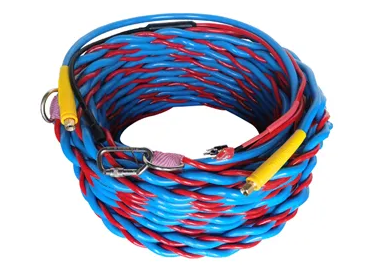
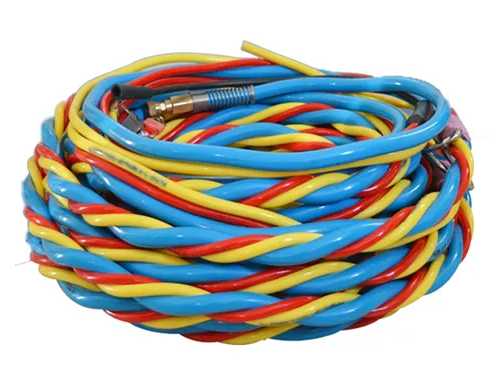
An umbilical cable is an integrated lifeline: a single managed assembly that connects the diver to topside support across every critical function simultaneously.
| Component | Function | Failure Risk if Under-Specified |
|---|---|---|
| Breathing gas hose(s) | Delivers breathing gas at required pressure and flow | Undersized ID causes pressure drop; incompatible fittings cause leaks |
| Communication conductors | Carries voice and signal between diver and topside | Undersized or unshielded conductors cause noise and signal drop-out |
| Power conductors | Delivers electrical power to diver tools or lighting | Undersized cross-section causes voltage drop and overheating |
| Strength member | Carries tensile load and protects internal components | Under-rated SWL causes elongation or failure under deployment load |
| Outer jacket | Protects all internal components from abrasion, cuts, and UV exposure | Wrong material for seabed contact causes premature wear-through |
| Hot water hose (optional) | Delivers heated water for thermal protection | Kink resistance and insulation retention are critical in cold water |
Terminations and strain relief: The termination is the highest-stress point on any umbilical cable. Poor potting, inadequate strain relief, or incorrect fitting installation concentrates load at the point where multiple different materials—hose, conductors, and strength member—must be managed simultaneously. Termination failures are the leading cause of umbilical removal from service before the end of its intended life.
Kink radius violations during deployment: Every umbilical cable has a minimum bend radius. When the deployment reel diameter is too small, when the umbilical runs over a sharp deck edge without a fairlead, or when it is coiled tightly for storage at a radius below specification, the internal hoses and conductors experience permanent deformation. The damage is often invisible externally until a gas hose fails a pressure test or a conductor develops an intermittent fault.
Jacket abrasion mismatch: Jacket material specified for open-water operations may fail rapidly in contact with rough concrete, barnacle-covered steel, or sharp reef structures. Procurement must confirm the actual contact surfaces the umbilical will encounter—not just the water depth.
Hydrostatic pressure test records for gas hoses
Electrical continuity and insulation resistance test records
Assembly method documentation and QC traceability per batch
Minimum bend radius and recommended reel diameter
Handling kit recommendations, including reel specifications, fairlead design, and deployment rollers
A complete specification eliminates the most common source of post-delivery disputes: the supplier built what was ordered, but what was ordered was not what the operation needed.
| Parameter | What to Define | Why It Matters |
|---|---|---|
| Overall OD | Measured diameter in mm | Controls reel capacity, fairlead sizing, and handling weight |
| Weight in air and water | kg/m in both conditions | Determines buoyancy management requirements |
| Strength member type and SWL | Material, construction, and safe working load | Must exceed maximum deployment load with an appropriate safety factor |
| Minimum bend radius | mm, under load and unloaded | Defines minimum reel diameter and deck handling constraints |
| Jacket material | Polyurethane, PVC, neoprene, or another specified compound | Must match abrasion, cut, UV, and chemical exposure conditions |
Hose count: Single or double, depending on redundancy requirements and system design.
Internal diameter: Sized to deliver the required gas flow at maximum depth without excessive pressure drop.
Working pressure and burst margin: Confirm against the topside panel supply pressure and required safety factor.
Fitting standard: Must be compatible with panel connections and helmet fittings before the order is placed.
Conductor count and cross-section: Calculate the required conductor size in mm² based on current draw and maximum voltage-drop tolerance over the umbilical length.
Shielding: Required for communication conductors in environments with electrical interference from tools or thrusters.
Twisted-pair construction: A standard requirement for voice communication pairs.
Fiber optic or coaxial conductors: Include these when video, high-bandwidth telemetry, or ROV-integrated operations are part of the workflow.
Hot water hose integration: Required for cold-water diving; specify insulation standard, OD, and flow capacity.
Buoyancy management: Neutral or positive buoyancy sections reduce diver handling load; float-collar spacing defines in-water behavior.
Anti-kink strain relief at terminations: Reduces the termination failure rate over the operational life.
Reinforced wear sections: Add jacket protection at high-contact zones such as deployment points and seabed contact areas.
Matching the umbilical cable configuration to actual operating conditions prevents both over-specification—paying for capability you do not need—and under-specification—paying for failures you did not budget for.
Primary requirements: Handling convenience, abrasion resistance against pier structures and hull coatings, and quick-repairable terminations for high-frequency use.
Configuration focus: Moderate OD for easy handling, a robust polyurethane jacket, a standard gas hose configuration, and replaceable end fittings that field technicians can service without factory support.
Primary requirements: Long lengths of 200 m or more, high strength-member SWL for deep deployment loads, reliable communications over distance, and robust strain relief at both ends.
Configuration focus: A high-tensile strength member, oversized conductors for voltage-drop management at depth, shielded communication pairs, anti-kink terminations, and comprehensive QA documentation per batch for client audit requirements.
Primary requirements: Maximum mechanical protection, high jacket cut and abrasion resistance, enhanced wear sections, and higher SWL.
Configuration focus: A heavy-duty jacket compound, reinforced wear zones at contact points, a higher safety factor on the strength member, and robust connectors rated for repeated high-load cycles.
Primary requirements: Snag resistance in cluttered underwater environments, buoyancy tuning for neutral behavior in confined spaces, and chemical resistance for treated water or process-fluid exposure.
Configuration focus: Buoyancy management throughout the assembly, a smooth jacket profile to reduce snagging, and a chemical-resistant jacket compound where exposure risk exists.
In 2026, the most financially significant specification decision is often not the one that reduces unit price—it is the one that reduces non-productive diver time (NDT). A diver umbilical for sale that handles better, fails less frequently, and is faster to inspect and redeploy delivers more operational value than a lower-cost alternative that requires more careful management, causes more handling delays, or fails before the end of the expected service interval.
Confirm the diving system interface. Map every connection point before writing the specification, including the gas panel connection type and pressure, communications system interface, power connector standard, and helmet fitting compatibility. Termination mismatches discovered on delivery are expensive to resolve under project schedule pressure.
Define the operating envelope. Maximum working depth determines the minimum hose pressure rating and strength-member SWL requirement. Current, temperature, and seabed contact surfaces define the jacket specification. The deck handling method, including reel type and fairlead geometry, defines the minimum bend-radius requirement.
Decide the length strategy. Choosing between one long umbilical cable and modular lengths with in-line connectors involves a tradeoff between handling simplicity and operational flexibility. For operations with variable depth requirements, modular lengths allow better length management and reduce unnecessary seabed abrasion. For high-frequency repeat dives to consistent depths, a single length is simpler to manage and inspect.
Lock the acceptance criteria. Define in the PO which tests are required before delivery acceptance:
Hydrostatic pressure testing for all gas hoses, including test pressure, hold time, and acceptance criteria
Electrical continuity and insulation resistance testing for each conductor, including the minimum insulation resistance value
Visual jacket inspection confirming there are no cuts, flat spots, or surface defects
Measured OD and weight per meter checked against the specified tolerance
Specify packaging and the deployment kit. Confirm the reel diameter, which must exceed the minimum bend-radius requirement of the umbilical cable, as well as end-cap protection for transit and storage, length-marking intervals, and serial/date labeling for traceability.
A complete PO for bulk diver umbilical for sale procurement should include:
Full bill of configuration: Hose IDs and working pressures, conductor sizes and count, jacket type and compound, termination design, and tolerances for OD and weight.
Required QA documents per delivery batch: Test records, material certificates, and assembly inspection records.
Spares list: End fittings by type and quantity, strain-relief components, and field repair kit specifications.
Packaging specification: Reel diameter, end protection, and labeling standards.
Post-dive inspection and logging: Every dive should include a post-use inspection of the full umbilical cable length. Check for cuts, flat spots, kinks, jacket abrasion, termination condition, and connector cleanliness. Log findings against the umbilical serial number and length position so wear patterns can be tracked throughout its operational life.
Rinse and storage protocol: Salt water accelerates degradation of jacket compounds and connector hardware. A freshwater rinse after every saltwater dive and storage on a correctly sized reel at ambient temperature can extend service life.
Periodic gas hose pressure tests: Gas hose integrity should be verified at defined intervals, not only after visible damage. A hose that passes visual inspection may still have internal liner degradation that only a pressure test reveals. Define the test interval in the maintenance SOP.
Electrical checks: Continuity and insulation resistance checks at defined intervals identify conductor degradation before it causes communication failures or electrical faults in service.
| TCO Factor | Procurement Action | Financial Impact |
|---|---|---|
| Repairability | Specify replaceable terminations and a field service kit | Extends service life and avoids full replacement after termination damage |
| Spares lead time | Confirm standard fittings and stock availability | Reduces downtime when repair is required |
| Warranty scope | Define warranty terms in the PO | Protects against early failure costs |
| QC traceability | Require batch documentation | Enables root-cause analysis and supports audit requirements |
| Handling guidance | Require technical documentation with the shipment | Reduces operator handling damage |
A higher-specification umbilical cable with better jacket abrasion resistance, higher-quality terminations, and replaceable end fittings typically costs 15–30% more per meter than a basic configuration. Against this premium, weigh:
One avoided termination failure that would otherwise require full umbilical replacement
One avoided project delay caused by a mid-operation gas hose failure
Reduced inspection time over the operational life due to fewer jacket defects
In most commercial diving operating environments, the premium specification pays back within the first avoided incident.
A bulk umbilical cable order should be driven by your depth profile, mechanical load requirements, handling method, topside system interfaces, and maintenance plan—not by a generic catalog specification. In 2026, the procurement teams delivering the best project outcomes are the ones that treat diver umbilical for sale selection as a system-level decision: confirming configuration, locking acceptance criteria, and planning for field maintenance before the PO is issued rather than after delivery.
Get the specification right upfront and the umbilical cable becomes a reliable operational asset. Get it wrong and it becomes the most expensive line item on a project budget that did not have room for surprises.
Visit the product page and submit your operating conditions, quantity, length and key specifications, target performance metrics, and current problems to receive a best-fit configuration recommendation and quotation.
An umbilical cable is an integrated lifeline assembly that connects a diver to the topside support system. It combines breathing gas supply hose or hoses, communication conductors for voice and signal, power conductors for diver tools and lighting, a strength member that carries tensile deployment load, and a protective outer jacket—all managed as a single assembly. Some configurations also include a hot water hose for thermal protection in cold-water operations. The umbilical is the diver's primary connection to life support, communication, and power throughout the dive.
An integrated umbilical cable typically outperforms a bundle of separate lines for repeated operations and bulk procurement. It reduces snagging risk by eliminating multiple lines that can tangle with each other or underwater structures, simplifies deployment and recovery for the topside team, makes inspection faster and more reliable, and standardizes the assembly so replacement lengths and spare parts remain consistent across the fleet. Separate lines may be appropriate for very simple operations or one-off scenarios, but integrated umbilicals generally reduce handling complexity and NDT in regular commercial diving operations.
Compare the cost premium of the higher-specification diver umbilical for sale against the financial exposure created by the failure modes it prevents. Key inputs include the value of one day of project downtime, the cost of an emergency umbilical replacement during a project, and the difference in inspection and management labor over the expected service life. In most offshore and nearshore commercial diving contexts, a single avoided project delay or mid-project umbilical failure can recover the full premium of a higher-specification configuration. The payback calculation is typically favorable within one operational season.
Not always, but interface verification is mandatory before ordering. The components most likely to require modification or adapter fittings include the gas panel connection type and thread standard, helmet gas inlet fitting, communications connector, and power connector. Most reputable umbilical cable suppliers can configure terminations to match existing topside equipment when interface requirements are specified in the PO. A termination mismatch discovered after delivery is a common and avoidable procurement problem.
To receive an accurate configuration recommendation and quotation for a diver umbilical for sale, provide the maximum working depth, required length or length range, gas hose internal diameter and working pressure, power requirements, conductor count, communications type, termination and fitting standards at both ends, strength-member safe working load, operating environment, buoyancy preference, quantity, delivery schedule, and any current performance issues or failure modes that you want the new configuration to address.